
VAT (Impuesto sobre el Valor Añadido, IVA) touches almost every business in Spain, and the rules often differ from what expat owners know from home. This guide covers the current Spanish VAT rates, when a business must register, the returns and invoices it must produce, and the main cross-border rules. For the first-year calendar as a whole, see our accounting essentials for a new business.
What are the current Spanish VAT rates and their applications?
The general VAT rate in Spain is 21% (Article 90 of the VAT Law). Article 91 sets reduced rates of 10% and 4% for specific goods and services. The rate depends on exactly what is supplied, so check the specific item before you invoice.
Which VAT rates apply to common goods and services in Spain?
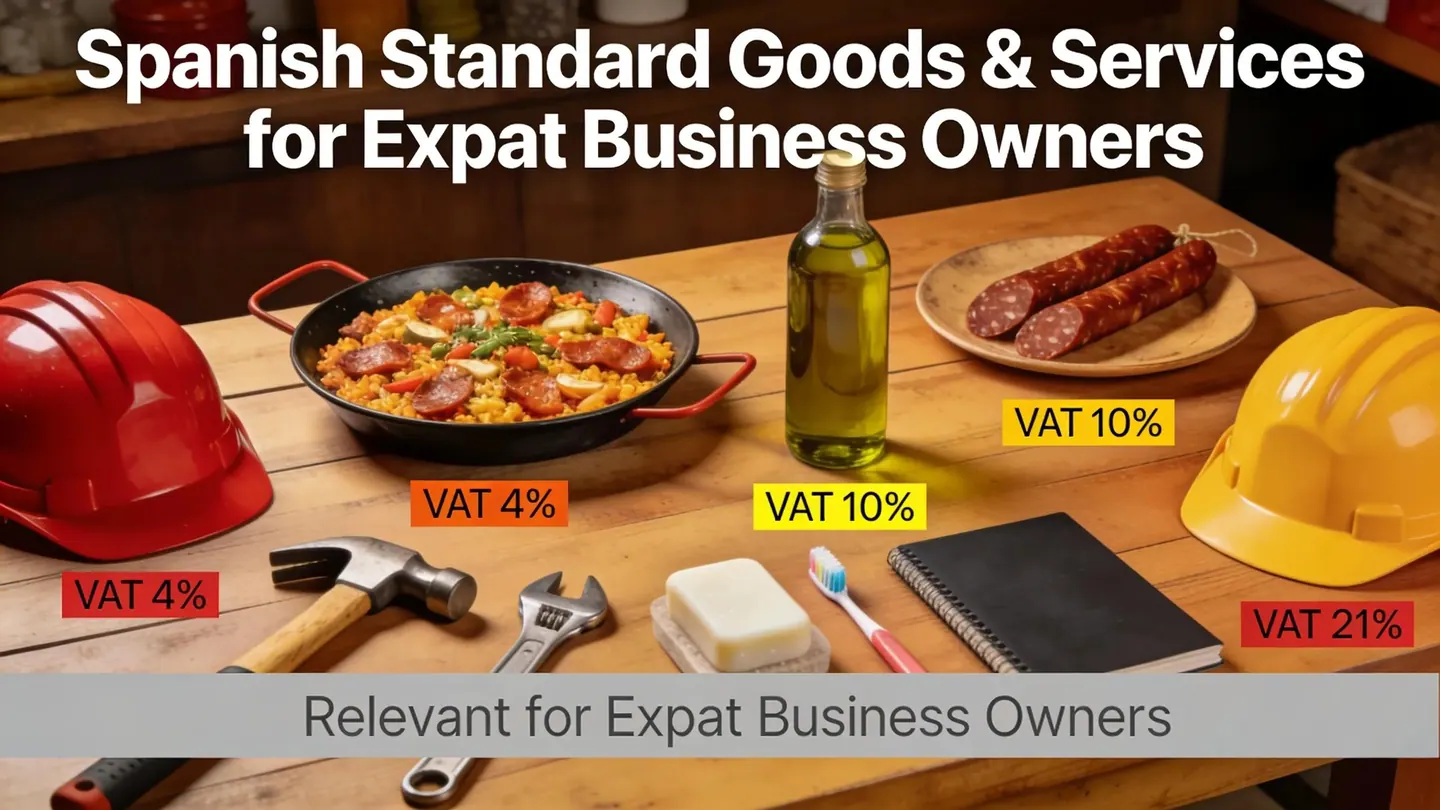
Some common examples from Articles 90 and 91 of the VAT Law:
| Goods/services | VAT rate | Examples and conditions |
|---|---|---|
| General rate | 21% | Most goods and services |
| Reduced rate | 10% | Among others, homes (buildings or parts of buildings fit for use as dwellings, with up to two parking spaces and annexes sold with them) |
| Reduced rate | 10% | Renovation and repair work on homes, when the conditions of Article 91 are met (for example, the contractor’s materials may not exceed 40% of the taxable amount) |
| Super-reduced rate | 4% | Among others, common bread |
These are examples, not a complete list. Food, for instance, can fall under 4%, 10% or 21% depending on the product.
How does EU legislation influence VAT rates and rules in Spain?
Spanish VAT is harmonised at EU level: the EU VAT Directive sets the common framework, and each member state applies it through its own law. In Spain that law is the VAT Law (Law 37/1992) and its Regulation. For the official EU texts and guidance, see the European Commission’s pages on VAT invoicing rules and VAT refunds.
How do expat business owners register for VAT in Spain?
A business that will carry out activities in Spain registers with the Tax Agency through the census declaration (Modelo 036), which must be filed before starting activities or carrying out transactions. In that form the business declares its VAT obligations and, if it will buy from or sell to businesses in other EU countries, asks to be included in the intra-community operators register (ROI).
Is there a VAT registration threshold in Spain?
No general threshold applies to businesses established in Spain. A business established here that makes supplies subject to VAT charges VAT from its first invoice, whatever its turnover.
- The 85,000 euro figure often quoted online is the maximum threshold the EU allows for national small-business exemption (“franchise”) schemes. Spain does not have such a scheme: the nine special VAT schemes listed in Article 120 of the VAT Law (consolidated text updated 7 October 2026) do not include one, and in 2024 the Tax Agency told tax professionals it was unknown whether Spain would adopt it.
- Since 1 January 2025, EU rules let small businesses established in one member state use the exemption scheme of other member states that have one. A Spanish business would apply that in those countries, not in Spain.
- The 35,000 euro distance-selling threshold that this article previously gave no longer exists. Since 1 July 2021, a single EU-wide threshold of 10,000 euros applies (Article 73 of the VAT Law): below it, a business established in one member state may charge its own country’s VAT on distance sales of goods and on certain electronic, telecommunications and broadcasting services to consumers in other member states; above it, VAT is due in the customer’s country, usually declared through the EU One Stop Shop. The 10,000 euro limit counts all such sales across the EU in the previous and the current year.
Businesses that are not established in Spain do not benefit from any turnover threshold for supplies taxed in Spain. Whether they must register depends on the type of transaction and who is liable for the VAT, which often needs a case-by-case review.
What documentation and support are needed to complete VAT registration?

The documents depend on whether you register as an individual or a company. Expect to provide:
- identification (NIE or passport for individuals; the company’s tax number and deed for companies);
- details of the activity and where it is carried out;
- a tax address in Spain, or a representative where the rules require one.
Given the complexities involved, professional help can be useful. MMR Consultant’s tax services team can prepare the census declaration and check your VAT position before you start.
What are the VAT compliance and filing obligations for expat businesses in Spain?
How often must VAT returns be filed and what are the invoicing rules?
Most businesses file the VAT return (Modelo 303) quarterly, within the first 20 calendar days of April, July and October, and within the first 30 calendar days of January for the fourth quarter. Businesses whose turnover exceeded 6,010,121.04 euros in the previous year, businesses in the monthly refund register, VAT groups and some others file monthly (Article 71 of the VAT Regulation).
Invoices must include the details required by Spanish invoicing rules, such as the parties’ tax numbers, the taxable amount, the rate and the VAT charged. For cross-border invoices, see the European Commission’s guide to VAT invoicing requirements.
What penalties or risks exist for non-compliance with Spanish VAT laws?
The General Tax Law classifies tax offences as minor, serious or very serious. Failing to pay tax that a correct return would have shown is an offence under Article 191, and the penalty can reach 100% to 150% of the unpaid amount in very serious cases. Beyond penalties, errors lead to late-payment interest, corrections and, sometimes, audits. Accurate records and timely returns are the best protection.
How can expat business owners reclaim VAT and manage cross-border rules in Spain?
What VAT refund mechanisms apply to foreign businesses operating in Spain?
- Businesses registered in Spain recover deductible input VAT through their VAT returns. A credit balance is usually carried forward and refunded in the last return of the year, unless the business is in the monthly refund register.
- Businesses not established in Spain can claim Spanish VAT through special refund procedures: one for businesses established in the EU, the Canary Islands, Ceuta or Melilla (Article 119 of the VAT Law), and one for businesses established elsewhere (Article 119 bis), which has additional conditions. See the European Commission’s page on VAT refunds.
How do EU cross-border VAT rules affect intra-community supplies and sales?
Supplies of goods dispatched to a business customer in another EU country are exempt from Spanish VAT when the conditions of Article 25 of the VAT Law are met, including that the customer has a valid EU VAT number and that the supply is included in the recapitulative statement (Modelo 349). Services between businesses in different member states are generally taxed where the customer is established, with the customer accounting for the VAT under the reverse-charge mechanism. Each transaction should be checked before you invoice.
How we can help
MMR Consultant is based in Málaga with offices in Marbella. Our tax services and accounting teams handle VAT registration, quarterly returns, intra-community transactions and refund claims for residents and non-residents. Contact us to review your VAT position.
Sources
Checked on 14 October 2026.
- Boletín Oficial del Estado, VAT Law (Law 37/1992), consolidated text updated 7 October 2026: Articles 25, 69, 73, 90, 91, 115, 119, 119 bis and 120, and the special schemes for distance sales (“Union scheme”, One Stop Shop).
- Boletín Oficial del Estado, VAT Regulation (Royal Decree 1624/1992), Article 71.
- Agencia Tributaria, minutes of the Forum of tax professional associations, 10 July 2024.
- Agencia Tributaria, EU small business scheme from 1 January 2025, page updated 13 October 2026.
- Agencia Tributaria, Modelo 036 frequently asked questions.
- European Commission, VAT invoicing and VAT refunds.
- Boletín Oficial del Estado, General Tax Law (Law 58/2003), Articles 183 and 191.
This article is general information, not tax advice for your case.